How Hyperscalers Are Reshaping Telecom’s Future
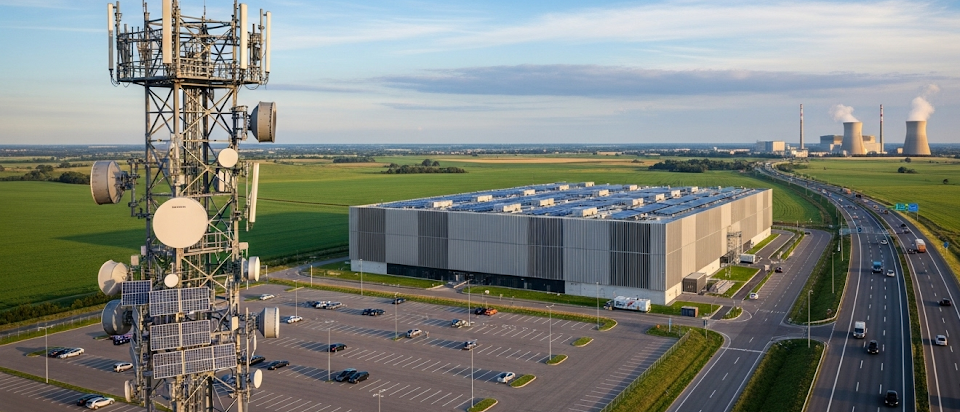
For over a century, telecom operators built the connective fabric of the modern world. But with the rise of AI, connectivity has entered a new phase increasingly defined by real-time inferencing across distributed datasets. This evolution is quietly reshaping the telco landscape, as hyperscalers like Microsoft, Google, and Amazon absorb functions once considered core to telecom: network orchestration, edge compute, and infrastructure design.
Before AI went mainstream, telecom had already adapted to supporting high-bandwidth connectivity—primarily from streaming media—driving the rise of edge data centers. Today’s challenge is different: moving massive datasets across compute clusters in real time. This shift has accelerated innovation in high-density fiber optics, now essential for transporting AI workloads across local, regional, and long-haul networks.
Fiber optics remain foundational to telecom’s competitive advantage, but hyperscalers are now leading its most advanced applications and innovations. Optical technologies like Dense Wavelength Division Multiplexing (DWDM)—capable of multi-terabits per second throughput—are increasingly deployed by hyperscalers to support AI workloads. Meanwhile, traditional telecoms are still navigating how to monetize multi-gigabit connections. The architectural core of AI infrastructure now resides where hyperscalers combine distributed compute with high-capacity optical networks.
This shift is reflected in vendor economics. Optical transport leaders like Ciena and Infinera, once reliant on telcos, now derive a growing share of revenue from hyperscalers. Ciena’s cloud-scale optical transport business has become a primary growth driver, while Infinera reports that hyperscalers now account for over half of its total revenue.
Hyperscalers are also gaining ground through partnerships. DISH, for example, is deploying its 5G Core and RAN directly onto AWS infrastructure—becoming the first U.S. telecom to fully embrace cloud-native networking. This recasts the definition of software-defined infrastructure and signals a new model for telco innovation.
Other carriers, like T-Mobile, are more cautious. T-Mobile built its 5G Core using Cisco and Red Hat, likely to preserve network sovereignty. But that choice comes with a challenge: matching the performance of someone like DISH using AWS. As AI increasingly shapes customer experience, the quality of a carrier’s AI backbone will become a key differentiator—and those with an edge will outpace competitors.
Elsewhere, Verizon and Lumen are pivoting toward AI-aligned infrastructure. Lumen’s divestment of copper assets in favor of fiber allows them to align with hyperscalers. Verizon is building what it calls “AI Connect Initiative”—an edge AI infrastructure with fiber, 5G, and strategic land—and backed by partners like NVIDIA and Google Cloud. Both companies are also leveraging their power and real estate holdings to explore scalable edge compute sites—anticipating the rise of edge inferencing that demands flexible deployments across varied geographies.
Despite growing interest in AI-driven orchestration, most telcos have overlooked a critical frontier: data center interconnects. This layer—essential for linking compute to fiber at scale—is now led by hyperscalers and infrastructure players like DC BLOX, QTS, and Flexential. Without a clear strategy here, traditional carriers risk losing relevance in the very domain where their inherent advantages could have secured a right to win.
Financially, the gap is widening. In 2025, hyperscalers are projected to spend over $350 billion on AI-related infrastructure, while U.S. telecoms will invest roughly $80 billion—mostly on maintaining access networks. Hyperscalers, by contrast, are building the high-density, AI-centric infrastructure that defines the modern internet.
If hyperscalers maintain this pace, acquisitions of telecom assets—or construction of their own long-haul fiber networks—seem inevitable. Google already functions as a telecom, offering broadband and owning thousands of miles of international and undersea fiber. Microsoft and Amazon haven’t taken direct ownership yet, but their strategic investments suggest growing interest. For telcos, this could be a double-edged opportunity amid ongoing industry consolidation. If Microsoft, Amazon, or Meta follow Google into core telecom operations, it would catalyze a profound reckoning for the sector.